Friday, 20 March 2015

Celebrations and Skydancing


 On Sunday 15th we celebrated the launch of our new bird hide - 'Laverock Hide'. We had a fantastic turnout, thank you to everyone who came along and all our volunteers who helped out.  Many thanks to Catherine Greer for these photos.


 A bright sunny day on the 19th saw the Hen Harriers at Langholm taking to the sky to begin their wonderful aerial display - Skydancing. Lets hope this is the beginning of another great season.
A few photos taken in previous years at Langholm.

(Photo by John Wright)

 If you come to Langholm to see the skydancing or the rest of the wonderful wildlife on the moor please park considerately, the Langholm - Newcastleton Road is single track and the passing places are vital. Please make sure you leave space for vehicles to pull into pass each other. Thank you

(Photo by John Wright)

(Photo by John Wright)

 Dry, bright days are few and far between in our part of the world so the keepering team were out working hard to burn patches of heather.


Thursday, 12 March 2015

Join us for the launch of our new bird hide


On Sunday 15th March we are holding an event to launch our new bird hide at the moorland feeding station at Broomholmshiels, Langholm Moor. The hide is the culmination of months of work by volunteers and will be a fantastic resource for the local community and visitors a like.

Join us for this free event on

Sunday 15th March

Moorland Bird Feeding Station

South-western end of the moor on the Broomholmshiels to Cronksbank Road. NY385 823

 Contact Cat for more details cat@langholminitiative.co.uk

There is parking onsite for those with limited mobility,  and more parking available at Broomholmshiels Farm (signs will be in place). A free minibus will be leaving Langholm Town square at 10.45 if anyone would like to use that service. Join us for hot drinks and cake.. chat to our volunteers and see what they have been up to.

The story of the Moorland Bird hide


When the Moorland Education Project began in April 2009, we were keenly aware that the project needed a focus for activities during the quieter Autumn and Winter months when the majority of moorland birds move away from the moor. A bird feeding station seemed like the answer and since its humble beginnings in November 2009 has grown into a great educational and wildlife resource. There have been fifty six different species of bird recorded seen or heard at the site and over 2000 birds ringed with the help of several project volunteers.

Since 2009, there have been several hundred activities linked directly to the feeding station and countless visitors to watch the birds. It has been an excellent resource for the Making the Most of Moorlands Project and is used regularly for school, youth group, volunteer and public activities.

The feeding station has been the focus of various practical conservation activities with youth groups, schools and even a group training event with Scottish Natural Heritage.

Several project volunteers regularly visit the site and photograph the wildlife, Tom Hutton and Sandy Gill in particular have been fantastic in allowing us to use their photographs for publicity, recording activities, sharing on Facebook, the project blog and local press.

For several years we have been thinking about building a more permanent weatherproof shelter at the feeding station to improve the visitor experience and allow people to get closer to the birds without causing disturbance. It has been quite a challenge to secure the funding, planning permission and materials for the hide but it is very satisfying to finally be able to welcome visitors to the hide.
 
 
Brambling

Great Spotted Woodpecker

mixed finch flock

The feeding station has been a useful ringing site allowing us to learn a little more about the avian visitors to the site
 
When local man, professional cabinet maker and project volunteer, Daniel Lacey, offered to be involved in the project, we knew we were in for a top quality bird hide. Daniel has not only helped design and build the hide, he has gone above and beyond, welcoming us into his workshop, allowing us to use tools and machinery and sharing his wood working skills with our younger volunteers. Daniel has given an incredible amount of time and effort and we can’t thank him enough.

Thanks to help from staff at Buccleuch Estates we managed to secure planning permission for the project to go ahead and back in October we began the hard work of preparing the wood. Keen to get volunteers involved with every stage of the hide building process, our team joined us from the very beginning. The work began on a very wet day in October milling the wood from the felled Larch trees. The group learned how to move the massive logs onto the saw mill and how to use the machinery safely to create the planks that would become the cladding for the walls of the hide. Working with a small group allowed us to get our young volunteers to get one to one guidance on technically difficult and potentially dangerous tasks. One of the project aims is to help young people to gain tangible skills and experience that would benefit them in their future careers. The young volunteers were able to learn directly from skilled professionals how to use the saw mill to cut the wood, how to move the wood safely and how to use the workshop machinery to prepare the wood for construction.

Our young volunteers have been working towards John Muir and Saltire awards –putting in around 30 – 40 hours each of volunteering time. They have volunteered after school and in the holidays, working around exams and their other commitments. I’ve been so impressed by their dedication and enthusiasm.

Once the wood had been given time to ‘settle’ it was time to get the hide in place. On site build began in January which presented its own challenges. The team has worked safely and sensibly in icy, windy and wet conditions. I can’t thank our volunteers enough for putting in hours and hours of hard work in challenging conditions, many hot cups of tea and a few packets of biscuits were consumed!  

This bird hide project would not have been possible without the incredible community support that we have received, we hope that the local communities around the moor will make use of the hide and help to take care of it. I’d like to thank everyone who has been involved especially all our volunteers, we couldn’t have done it without you. Many thanks to Buccleuch Estates for donations of materials and help with the planning process.

Thank you to our funders for making our work possible – Scottish Natural Heritage, the Holywood Trust, Esmee Fairbairn Foundation and NGO Educational Trust. 


See November 4th Post for details of  the  first phase of construction, milling the wood and the workshop indoor work... http://langholmmoorland.blogspot.co.uk/search?updated-min=2014-01-01T00:00:00-08:00&updated-max=2015-01-01T00:00:00-08:00&max-results=45


The raw materials donated by Buccleuch Estates October 2014

 At the end of January we began the on site construction, our volunteers have been amazing braving freezing temperatures, ice, snow and 35mph winds.. a Health and safety challenge to say the least!

 
Volunteers measuring out the post holes and beginning to dig


Our volunteers worked in snow and ice to complete the project

Midway through construction we knew the views form the hide would be something special

Adam and Alasdair preparing the floor of the hide

Work experience student William learning some woodworking skills from Daniel

Bug Hotel
As well as building the hide, volunteers have moved and rebuilt the bug hotel. The local Barn Owls have adopted the feeding station  - using the hide and fence posts as a perch and leaving their pellets behind each morning for us to find.

Barn owl pellets

Not quite our target species for the bird feeding station but you have to admire her flexibility


Our moorland efforts were rewarded with lovely views  a skein of  'pinkies' (Pink footed Geese)
 
Over the last six years we have run over 400 activities and engaged with over 12,500 participants. So proud of this phenomenal effort – wouldn’t be possible without the hard work of our volunteers and support of the local community. 
We hope that the bird hide will be a valuable asset for the communities surrounding the moor and act as a focal point for visitors to the moor. We hope to run several events in the coming months and years to help people identify the different species and photograph the local wildlife.

We are very proud of what the project has achieved over the last six years and would like to continue that work into the future. Securing funding for community / education work like ours is becoming increasing difficult and local donations however large or small can be really valuable in helping us achieve…. If you would like to help by donating, please find a donations form on our website www.langholmmoorland.co.uk  or at the Langholm Initiative Office.

 Nothing new from Hattie, Grainne or Annie, all safe and well.


Monday, 23 February 2015

February 2015

For the first time Mother and Daughter, Grainne and Annie, seem to be in sync. Both have made a move north within hours of each other, most likely in response to the change in the weather. They have both moved back to their favored wintering grounds.  Have we seen the last of the winter weather or could another cold snap drive the birds south again?


The mild and sunny weather last weekend also saw the first Lapwing flocks and Skylarks back on the moor.. Wonderful to hear the Skylarks song back in the moorland skies.


Highlights from this winter on the moor

Click on any of these images to see them enlarged.

 A few highlights from the winter included a juvenile Rough Legged Buzzard that visited Langholm moor briefly in the first part of the winter. Rough Legged Buzzards breed in Scandanavia and small numbers of birds winter here in the UK usually in the East. Last Autumn there was an influx with many birds seen in Northumberland and Yorkshire and we were lucky enough to see one here at Langholm. Rough Legged buzzards have a white tail with a black terminal band, pale head, black belly, white under wings with black carpal patch.

Rough Legged Buzzard (JW)

Rough Legged Buzzard (JW)

Hen Harriers


With 47 fledged young at Langholm last season we had high hopes we would see one or two harriers about over the winter. A great deal of patience and multiple thermal layers have been required to get these views of harriers, but well worth it. Many thanks to John Wright for these photos and ID guidance.

How is your Hen Harrier ID?

Adults Hen Harriers are pretty easy to tell apart, the obvious sexual dimorphism meant males and female harriers were once thought to be separate species but how about the juveniles still in their brown plumage?

Juvenile males differ from females by being slighter in build, if you have several harriers together, you can often tell males from females by their size, otherwise is it down to experience - a good excuse to get out and spend every spare minute watching hen harriers!

Young males also have a pale iris - unless you have an excellent view or superb photography skills, this is not always easy to see. 

Young males also display sparse barring in the outer half of the primaries. Juvenile females have coarser barring as can be seen when comparing these two juveniles.

Juvenile male HH (JW)

Juvenile Female HH (JW)

Juvenile Male Hen Harrier (JW)

Juvenile Male Hen Harrier colour ringed bird (JW)

Juvenile Female Hen Harrier (JW)
The male Hen Harrier could be called adult if only seen from below but the dark saddle and wing bars clearly make it an immature bird (3cy).


Red Grouse


And not forgetting the Red Grouse, I never get sick of watching these beautiful and characterful birds strut and chuckle amongst the heather.

Female red Grouse (JW)

Male Red Grouse (JW)

Red Grouse in Flight (JW)

Male Red Grouse (JW)

Some other highlights


Moon over the moor (JW)
Around New Year the West of Scotland was battered by gale force winds.. while it was our friends further north that were hit directly by the so called 'weather bomb' Langholm got the tail end.. winds strong enough to bring down an unexpected visitor to the moor. After bouncing and stumbling through the heather the Fulmar eventually managed to get back into the air and head for the sea.
Sketch by John Wright
 A very elusive bird, not a common sight and such a treat to see.. a Goshawk! What a bird!
Juvenile Goshawk (JW)

Juvenile Goshawk (JW)

Number 69 wing tagged Buzzard, seen regularly on the moor

Monday, 16 February 2015


February 2015 - We call him the Owl man!

 
Regular blog readers will know that 2014 was an incredible season on Langholm moor. A mild winter and incredibly high vole numbers were perhaps the triggers for an excellent breeding season for many raptors including  Hen Harriers and Short Eared Owls. The moor welcomed many visitors to perch on the roadside and watch the wonderful views of birds  all around; one such visitor became a semi-permanent feature on the roadside. .  we called him 'the owl man'.
 
I hope you enjoy this guest blog by Bryan Benn aka (The owl man)


Langholm Moor Short-eared Owls in 2014


In recent years I have developed an almost obsessional love for owls, especially Short-eareds. I am now approaching four years in maybe a seven to eight year period of time writing a book about those beautiful lemon-yellow eyed creatures. I’m not a life long birder, indeed I still describe my identification skills for our feathered friends as being OK for Sparrows and Albatrosses, but still pretty useless for those falling in between! After I lost my wife a good friend introduced me to birding as a way of trying to fill a big gap in my life and the first ”unusual” bird we saw was a Short-eared owl, slowly hopping from post to post in front as we drove an Isle of Sheppey, (Kent), marsh road at walking pace. An amazing and beautiful creature about which I soon developed an insatiable desire to find out all I could. Plenty of scientific papers written on various aspects of their lives, but no book. So I decided to write one myself, and thus started the long road that eventually saw me arrive on Langholm Moor on 23rd May last year.

A road that has already seen me spend vast amounts of time observing and photographing Short-eared owls, (and any other owls that came close), as well as driving to many locations around the British Isles to broaden my knowledge and understanding of them. From South Wales to the Outer Hebrides, Salisbury Plain to the Orkneys and many other places in between. I have seen and learned much and received a great deal of help, (especially on the Orkneys earlier this year), but nothing substantial on breeding season activity. Until I came to Langholm Moor in 2014.

My first visit to Langholm in May was thanks to Sonja Ludwig who had responded very quickly to one of many requests I sent out to various organisations for help with my Shortie breeding season field work. She told me 2014 was an exceptional year for these owls breeding on the moor and on arrival I was immediately watching various males hurrying about feeding their females and the hatched young. As well as vigorously defending their well defined territories from adjoining males and indeed any bird seen as a likely threat to their food supply, (primarily voles), and the young owlets.


On just my second day Mac Hotson and Sonja, (members of the raptor study group), allowed me to accompany them to a Short-eared owl nest where they were scheduled to ring the owlets.

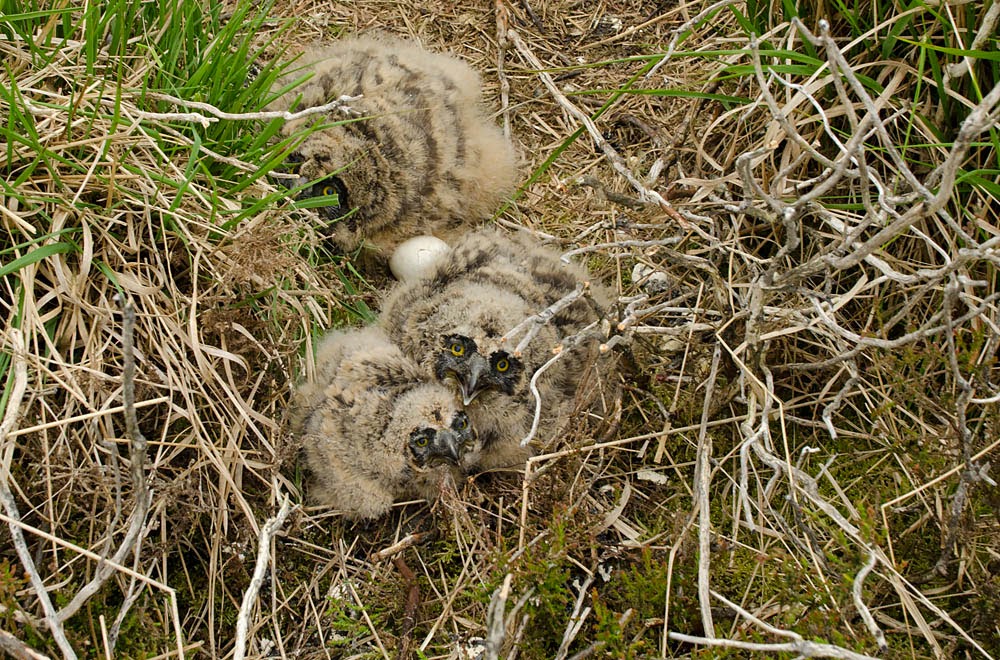
That nest visit saw the male making his distraction display as we got close: a variation of the broken wing display used by a number of other birds. The female stayed on the very rudimentary nest in amongst some taller grasses, (Shorties are ground nesting owls), until we were almost upon her, leaving three young owlets to be rung. Two were healthy sizes and looked in good shape, one was clearly not and the verdict from Mac and Sonja was that it would not survive long. Close by was a 12 day old owlet that had already started it’s wandering from the nest. As ground nesting owls part of their survival strategy is for the young to leave the nest very early and spread out in the adjoining habitat, thus allowing at least some to survive if a predator such as a fox finds the nest. That means the adults have to be good not only at making a number of kills each day to feed them, but also at finding their wandering young who can be up to 200 metres from the nest as they grow. That process is helped by the young making lots of food begging hisses when the adults are flying near, a sound that characterised that part of the breeding cycle over much of the moor.


From then onwards in what became numerous trips from Kent to Scotland, I spent a great deal of time on a moorland road watching a number of breeding territories whilst always making sure I minimised any disruption to the very friendly local people, the owls, and I kept well away from the many Hen Harriers breeding there. Visible activity peaked from mid June to early July as the juvenile owls started to fly, but were still dependant on the adults for food. Meaning very hard work for the adults and not very good news for the many voles on the moor. Large numbers of those latter creatures, (their numbers are cyclical), was the reason for the good number of Short-eared owls breeding on the moor in 2014. A more normal level of voles would see only a small number of owls, and they would be very thinly spread.


June saw the juveniles flying, often together as a family unit as they emerged in the evenings from their daytime roosts: all these owls showing a distinct preference for nocturnal activity. Something not that widely realised by those who only watch their daylight activities in the winter months on coastal marshes and lowland in other parts of Britain.  All too soon the sights of several young lined up on fences where they exist on the moor waiting their first feed of the evening was just a memory as they became well and truly fledged, fending for themselves.


Then, from late July and continuing into October, the owls started to disperse from their breeding territories. A few maybe just across the moor before a final departure, but with the majority no doubt heading directly South to seek milder over wintering areas in Britain. With some possibly going much further South than our shores in search of an area where adverse winter weather does not stop easy access to a reliable food supply.  A very few stayed into November, becoming hard to find due to their continuing nocturnal behaviour.  It will be touch and go if those few stay on the moor or if any reduction in voles and/or bad weather forces them to leave too.


My visits have continued as I need to record the owls’ departures and the empty areas of moor where only a few months earlier I was so regularly finding these beautiful creatures in good numbers. A sadness at times seeing the emptiness.  But an understanding and appreciation that all those who work on Langholm Moor on the project have created an environment with the side effect of helping swell the British population of Short-eared owls. 2014 has been exceptional I know due to the large number of voles, but I do hope that 2015 and future years still see at least some of these lovely owls choosing to breed in such a wonderful and friendly part of Scotland.

Bryan Benn, Kent, England. February 2015 


Tuesday, 3 February 2015

Hattie stays put but Grainne has left the moor for the first time!


After Annie's move south to WWT Caelaverock, we've been watching Hattie and Grainne carefully to see how they would react to the snow. Unlike Annie, who left the moor less than a month after fledging the nest in summer 2014, Hattie and Grainne (fledged summer 2013) have never left the moor. An unusually mild winter last year gave them no reason to leave, clearly conditions were right for  them to stay and breed. This winter has been a bit different, recent snowfall, persistent cold temperatures and string northerly winds has made life a little more challenging. Hattie and Grainne have dealt with the challenge in different ways. Grainne has left the moor for the first time in her life and flown south just north of Carlisle.
 
 Annie seems settled for now in the WWT Caerlaverock area.


The excitement of following the three Langholm harriers is tempered by the sad news of a bird tagged in Ireland the same summer as Hattie and Grainne - Heather was found shot dead in County Kerry.
 http://www.independent.ie/irish-news/rare-bird-and-blog-star-heather-the-harrier-shot-dead-30954300.html